


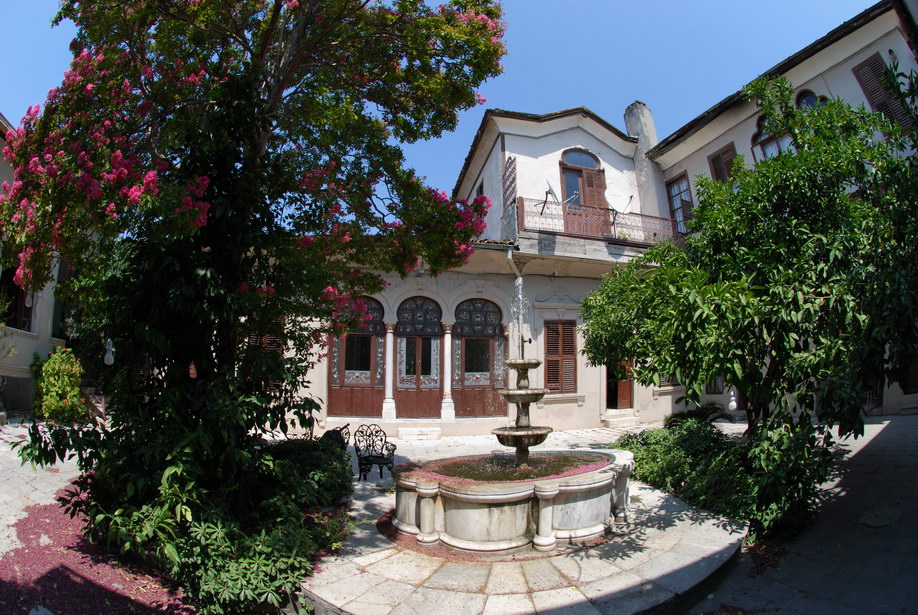


As I walked through the old streets of Antakya, the first thing I noticed was how little the houses revealed of themselves to the outside world. Narrow lanes winding between high walls, unassuming doorways, and the occasional small window offered few clues about the lives unfolding beyond them. The architecture seemed deliberately inward-looking, shaped to protect the private world of each home from the activity and curious eyes of the street.
Yet behind these modest entrances lay an entirely different world. Traditional Antakya houses were generally arranged around an inner courtyard. Rather than opening directly onto the street, rooms faced this shared space at the heart of family life. Bringing daylight and fresh air into the home, courtyards were also places for everyday work, gathering with family, resting, and receiving guests. Stone paving, plants, and carefully crafted architectural details gave each courtyard its own character. Passing from a narrow, shaded lane into such an open interior was one of the most striking experiences of Antakya's architecture.
Climate also played a decisive role in shaping these houses. Thick stone walls helped moderate indoor temperatures, while shaded courtyards and semi-open spaces provided relief during the long, hot summers. The relationship between enclosed rooms and open living areas was not merely an aesthetic choice; it grew out of the practical needs of daily life. The direction of the sun, shade, airflow, and the changing seasons had shaped these homes over centuries.
Antakya's traditional houses cannot be separated from the city's layered cultural past. Known in antiquity as Antioch, the city was a meeting place for different civilizations, beliefs, and cultures throughout its history. In a region where Muslim, Christian, and Jewish communities lived alongside one another for centuries, architecture also carried traces of a shared culture of everyday life. Although individual buildings cannot always be assigned to a particular community, the houses of the historic neighborhoods remained tangible records of local craftsmanship, traditions, and experiences of coexistence.
When I photographed these streets in 2009 and 2010, what interested me most was the relationship between houses and streets. The lanes did not appear to follow a predetermined geometric plan. Rather, the buildings seemed to have moved closer together over time, leaving the streets to find their own paths between them. Successive stone walls, projecting upper floors, doorways, and unexpected corners created a changing scene at every step. Walking through Antakya's narrow streets felt less like following a set route than discovering the city anew around every corner.
Looking at these photographs today, I see more than examples of traditional domestic architecture. I also see the boundaries between public space and private life, the relationship between climate and shelter, and the culture of neighbors and neighborhoods. The beauty of Antakya's houses was not always visible from the street. Much of it lay concealed behind high walls, in courtyards and in the details of daily life.
These photographs, however, now carry a very different meaning for me. When I took them, I could not have known that the earthquakes of 6 February 2023 would cause such devastating destruction in Antakya. The disaster, which claimed thousands of lives, also severely damaged the city's historic fabric. Buildings I once photographed for their architecture and the life of their streets now bear witness to the past of a city that has changed profoundly.
The photographs I made in Antakya's old streets now preserve not only an architectural heritage, but also the life shaped within it and the memory of the city before the earthquakes.